First Notes on the Anon Field of Cultural Production

Finally, Some Good News was one of the first self-published books I read. I bought it at the same time I bought Harassment Architecture and Bronze Age Mindset. At this point, I think I’ve probably listened to most of the interviews Delicious Tacos has done with various podcasts (not that there are that many out there). In interviews, Delicious Tacos never fails to comment on the fact that there’s no way he could find a publisher. People, he says, find the kinds of things he writes about offensive, and publishing under his own name would make him unemployable. Is this the case? I’m not sure. Probably. I haven’t tried to get a job while writing the kind of fiction Delicious Tacos does, but I am writing this anonymously.
I find it interesting how what once was taboo becomes normalized. Consider, for instance, Charles Baudelaire. Basically, Baudelaire was deplorable: shitting his guts out because of drinking too much beer while hiding from debt collectors in a nasty hotel with his pet bat. A totally absurd figure. Today, though, Baudelaire is hailed by university literature departments as one of the inaugural figures of modern literature. Yet while contemporary professors are still willing to lavish praise on Baudelaire, I find it hard to believe that were Baudelaire alive he would have much respect for these professors and their institutions.
I was in a class once where someone made this point. The professor replied that Baudelaire would be proud to be recognized as a great poet now; the professor said that Baudelaire’s current status (the recognition that Baudelaire has “won”) meant that Baudelaire was right about what he was doing back then. Essentially, the professor said that Baudelaire had been playing the long game and won.
But take a look at “The Bad Glazier,” one of the short pieces in Paris Spleen. Due to its brevity, and to save readers the trouble of tracking down a good translation, I quote it in its entirety here (from the New Directions translation):
There are certain natures, purely contemplative and totally unfit for action, which nevertheless, moved by some mysterious and unaccountable impulse, act at times with a rapidity of which they would never have dreamed themselves capable.
Like the man who, dreading some painful news, instead of going for his mail as usual, cravenly prowls around his concierge’s door without daring to go in; or the one who keeps a letter for two weeks without opening it; or the man who only makes up his mind at the end of six months to do something that has urgently needed doing for a year; then, all of a sudden, they feel themselves hurled into action by an irresistible force, like an arrow out of a bow. The moralist and the doctor, who pretend to know everything, are unable to explain how these voluptuous, indolent souls suddenly acquire such a mad energy, or how it is that, although incapable of doing the simplest and most necessary things, they yet discover in themselves at a given moment a lavish courage for performing the most absurd and the most dangerous acts.
One of my friends, the most inoffensive dreamer that ever lived, once set fire to a forest to see, he explained, if it were really as easy to start a fire as people said. Ten times in succession the experiment failed; but the eleventh time it succeeded only too well.
Another will light a cigar standing beside a keg of gunpowder, just to see, to find out, to test his luck, to prove himself he has enough energy to play the gambler, to taste the pleasures of fear, or for no reason at all, through caprice, through idleness.
It is the kind of energy that springs from boredom and daydreaming; and those who display it so unexpectedly are, in general, as I have said, the most indolent and dreamiest of mortals.
And another man I know, who is so shy that he lowers his eyes even when men look at him, so shy that it takes all the poor courage he can muster to enter a café or, at the theatre, to approach the ticket controlleurs who seem to him invested with all the majesty of Minos, Iacchus and Radamanthus, will suddenly throw his arms around an old man in the street and kiss him impetuously before the astonished eyes of the passers-by.
Why? Because… because suddenly that particular physiognomy seemed irresistibly appealing? Perhaps; but it would probably be nearer the truth to suppose that he himself has no idea why.
I, too, have more than once been the victim of these outbursts of energy which justify our concluding that some malicious Demon gets into us, forcing us, in spite of ourselves, to carry out his most absurd whims.
One morning I got up feeling out of sorts, sad, and worn out with idleness, and with what seemed to me a compelling urge to do something extraordinary, to perform some brilliant deed. And I opened the window — alas!
(I should like to point out that with certain persons playing practical jokes is not the result of planning or scheming, but a fortuitous inspiration akin, if only because of the compelling force of the impulse, to that humor called hysterical by doctors, satanic by those with more insight than doctors, that drives us toward a multitude of dangerous or improper actions.)
The first person I noticed in the street was a glazier whose piercing and discordant cry floated up to me through the heavy, filthy Paris air. It would be impossible for me to say why I was suddenly seized by an arbitrary loathing for this poor man.
‘Hey! Hey!’ I shouted, motioning him to come up. And the thought that my room was up six flights of stairs, and that the man must be having a terrible time getting up them with his fragile wares, added not a little to my hilarity.
Finally he appeared. After looking curiously over his panes of glass one by one, I exclaimed: ‘What! You have no colored glass, no pink, no red, no blue! No magic panes, no panes of Paradise? Scoundrel, what do you mean by going into poor neighborhoods without a single glass to make life beautiful!’ And I pushed him, stumbling and grumbling, toward the stairs.
Going out on my balcony I picked up a little flower pot, and when the glazier appeared at the entrance below, I let my engine of war fall down perpendicularly on the edge of his pack. The shock knocked him over and, falling on his back, he succeeded in breaking the rest of his poor ambulatory stock with a shattering noise as of lightning striking a crystal palace.
And drunk with my madness, I shouted down at him furiously: ‘Make life beautiful! Make life beautiful!’
Such erratic pranks are not without danger and one often has to pay dearly for them. But what is an eternity of damnation compared to an infinity of pleasure in a single second?
Both in terms of its content as well as the fragmentary nature of Paris Spleen as a whole, “The Bad Glazier” reads like something out of one of Mike Ma’s books. Or I suppose it would be more accurate to say: many of Ma’s fragments read like something out of Paris Spleen. I realize it may be trite to say I think Baudelaire would be “cancelled” the way folks like Ma have been were he writing today, but it seems very likely to me that were Baudelaire writing today he’d (1) be writing things not unlike (forgive the double negative, which is for me unavoidable here) Ma, BAP, and Delicious Tacos and (2) publishing in the manner these authors do.
So, one thing I want to suggest, which may not be particularly groundbreaking to those who read this Substack post, is that being on the fringe (or perhaps it would be better said: positioning oneself against cultural norms) in the way that authors like Delicious Tacos seem to be isn’t unprecedented. What I think may be new, however, is that people in institutions seem to be particularly dismissive of this fringe. Or maybe a better way of putting it would be to say that institutions have misidentified the fringe. Baudelaire was scandalous during his time, but he also captivated the public’s attention through his antics in a way that self-publishing anons don’t really seem to. Other than the very occasional scare piece, these anons strike me as being more “under the radar” than figures like them were in the past.
This could in part be influenced by an increase in the number of literate people. A cursory Google search indicates that in the 19th-century literacy rates in France ranged from 20-60% for men and 10-35% for women whereas now the rate is 99%. With a smaller reading public, Baudelaire could have more easily captured the attention of readers. When everyone can read (and write), it’s likely more difficult to get everyone’s attention (and there’s more being written to pay attention to). At the same time, there also seems to be more homogeneity in what this larger reading public is paying attention to than ever.
Maybe I have my head too far up my ass to know what’s “good” and shouldn’t be comparing Delicious Tacos et al. to Baudelaire, but seriously—read “The Bad Glazier” and then take a look at the first vignette in Harassment Architecture (“Opening”). (As I’ve written, I think both of Ma’s books—and I’m finding Paul Town’s books—could have been more tightly written, but the best moments in Ma’s books aren’t unlike—sorry—Paris Spleen.) If what I’m tracing here is at all accurate, there would seem to be a shift that has less to do with content (the things in the books that are often considered to be objectionable) than management of public sentiment. I suspect that there remains a latent interest—and even acceptance—of the sort of content found in these books that get them flagged as “dissident,” etcetera. I think that “management” is a good term to use here because I think that more people would be buying these books if they were to be promoted by major publications. But they’re not.
While there are more people reading now, often it seems that more people than ever are reading the same things; the larger reading public often appears to coincide with a greater homogeneity. But I’m not entirely sure if this is the case. On the one hand, it could be that with more people reading, the percentage of people who are reading the same things becomes more apparent than was apparent when there were fewer people reading. In other words, the percentages have remained relatively constant, but what those percentages are have become more visible. On the other hand, it could be that there is, in fact, more homogeneity, and this homogeneity would likely have to do with the centralization of media outlets and publishing houses. I tend to think that it would be easy to overestimate the variety of writing that would have been happening in the past.
This all leads me to some thoughts about publishing.
Despite certain doubts about his model of “subjectification” and the field of sociology more generally, I consider French sociologist Pierre Bourdieu’s writings on culture to be a helpful lens through which to consider our recent self-publishing phenomenon. In his writings about cultural production, Bourdieu posited two modes of hierarchization: the heteronomous principle and the autonomous principle. The heteronomous principle is the field of power that’s antagonistic to the literary and artistic fields; it measures success in predominantly economic terms. The autonomous principle is directed towards its own logic and measures success in the opposite way; it takes low sales, for example, as a sign of success. Bourdieu maintained that the literary and artistic field remain inscribed within the broader field of class and power relations and can never become completely autonomous.
The upshot of the two modes of hierarchization Bourdieu outlines is that the artistic fields of production are able to develop their own logics. The artistic fields develop rules that only make sense within their boundaries; these fields are able to split off and achieve relative autonomy from economic fields. Put very simply (perhaps too simply), Bourdieu is describing something like a hipster logic. The artistic fields tend to place more weight on clout than strict economic profit.
Bourdieu was particularly interested in the second half of the 19th-century. He claimed that literature became autonomous during this period as a consequence of a unique intersection of economic and symbolic hierarchies. Bourdieu outlined three modes of legitimating cultural products: (1) specific principles of legitimacy (this is autonomous art, or art for art’s sake), (2) legitimacy established by the dominant class (this was determined by bourgeois taste), and (3) legitimacy from the masses (this was determined by popular culture). Bourdieu saw poetry as the genre corresponding most to the first mode of legitimating cultural products, theatre as the genre corresponding most to the second mode of legitimating cultural products, and the novel as corresponding most to the third mode of legitimating cultural products. At this time, poetry made the least money and had the smallest audience (poetry was—and, it seems to me, continues to be—written for poets), theatre did well both financially and in terms of audience size, and the novel did well financially and had the biggest audience.
On the one hand, the anonymous self-publishing sphere appears to operate according to dynamics closest to those Bourdieu identified as predominant in poetry during the 19th-century. Anons self-publishing anonymously seem to have a relatively small audience size and bring in a relatively low amount of money. (If I recall correctly, Delicious Tacos—one of the most successful self-publishing anons—has mentioned that after all the books he’s written he’s now bringing in about $20,000/year, which—while certainly nothing to scoff at—isn’t livable in the many countries. I think that Paul Town said he’s made somewhere between $10-15,000 off of all his books over the last couple of years on Justin Murphey’s podcast. ) But on the other hand, due to technological changes more of these anonymous self-publishing authors appear to be able to do without much of the publishing apparatus that cuts into an author’s profits. This means that unlike the 19th century poetry world, authors now may be able to do relatively well financially with a relatively small audience.
Another difference between the self-publishing anons and 19th-century poets is that the self-publishing anons don’t overtly disavow financial success in the way that the 19th-century creatives in France that Bourdieu writes about did. Many of these 19th-century artists had connections that allowed them to pursue their art without having to work (and according to Bourdieu this was one of the reasons that people like Manet and Flaubert were able to effect a “symbolic revolution”). In contrast, today’s anons take financial success as proof that the cultural sphere they are a part of is worth being a part of. Consider, for example, the following telegram post from BAP promoting Zero HP’s recent book They Had No Deepness of Earth:
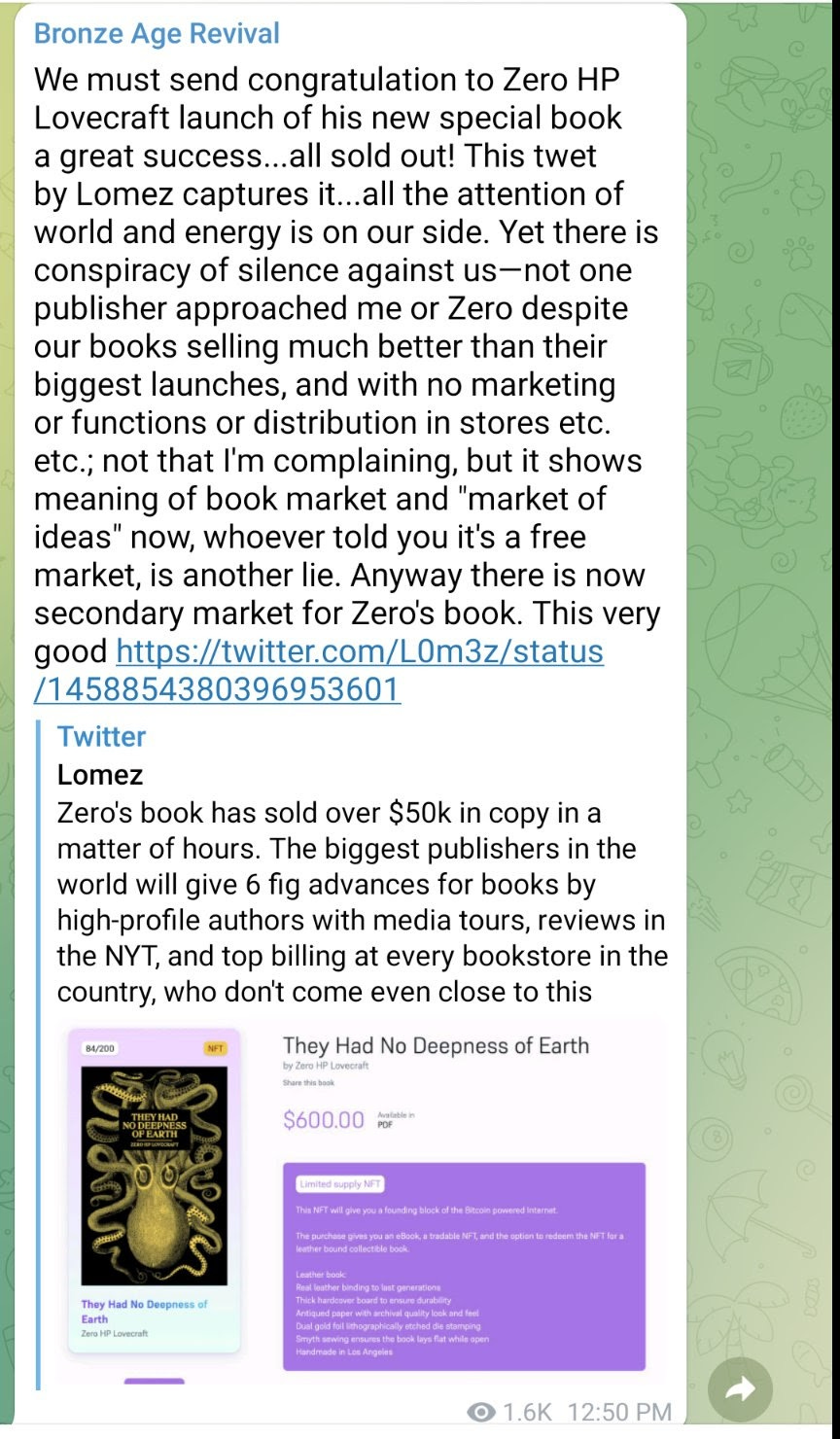
Posts like this one are common to find in this part of Twitter. Delicious Tacos, Mike Ma, BAP, et al. validate their writing through sales. Many anons point to sales as evidence of their alternative subculture being viable. In my next post, I want to consider the difference between our anons’ relationship to sales and 19th-century artists’ relationship to sales in relation to what Bourdieu described as the “double rejection” of the 19th-century artists.